A simple, doable way to grow food—without overwhelm
Before You Start: Helpful Resources (Save These)
Let’s get this out of the way first.
You do not need to read everything, buy everything, or understand everything today.
But if you’re the kind of person who likes to bookmark things and come back later (hi, same), this section is for you.
Below are a few resources that can help as you go. You don’t need them all right now. Think of this as a gentle reference shelf—not homework.
Helpful Resources
The Official Square Foot Gardening Book
This is the book that originally introduced square foot gardening—and it’s still one of the most thorough resources out there if you want to go deeper.
You don’t need to read it cover to cover to get value from it. Many people keep it nearby and reference it as questions come up throughout the season.
Think of it as a reference guide, not required homework.
Square Foot Gardening Planner
Square Foot Gardening Planner is a simple, practical companion if you like writing things down and seeing your garden take shape on paper. It gives you space to plan each square, track what you planted, and jot notes as the season unfolds—without turning gardening into a complicated project. Think of it as a calm place to capture what you’re learning, not something you have to fill out perfectly.
- Beginner overview of square foot gardening
- Recommended raised bed sizes & layouts
- Simple soil mix explanations
- Easy seed spacing guides
- Kid-friendly gardening ideas
- Seasonal planting guides by growing zone
- Printable garden planners & checklists
(We’ll link to these throughout the site so you can explore at your own pace.)
A Gentle Introduction for New Homesteaders
If you’re here, I’m guessing one of two things is true:
Either you really want to grow some of your own food…
or you’ve already tried, got overwhelmed, and quietly decided you’re “just not a garden person.”
I want to say this clearly, right up front:
Most people don’t quit gardening because they’re bad at it.
They quit because they start with too much, too fast, and no structure.
Square foot gardening exists to solve that exact problem.
It’s not fancy.
It’s not trendy.
It doesn’t require a big yard, expensive tools, or a personality overhaul.
It’s just a simple system that helps normal people grow real food—one small step at a time.
And if you’ve ever stood in your yard (or on your patio, or by a sunny window) thinking,
“I don’t even know where to start,”
this method was basically made for you.
What Is Square Foot Gardening (And Why It’s So Beginner-Friendly)
Square foot gardening is exactly what it sounds like.
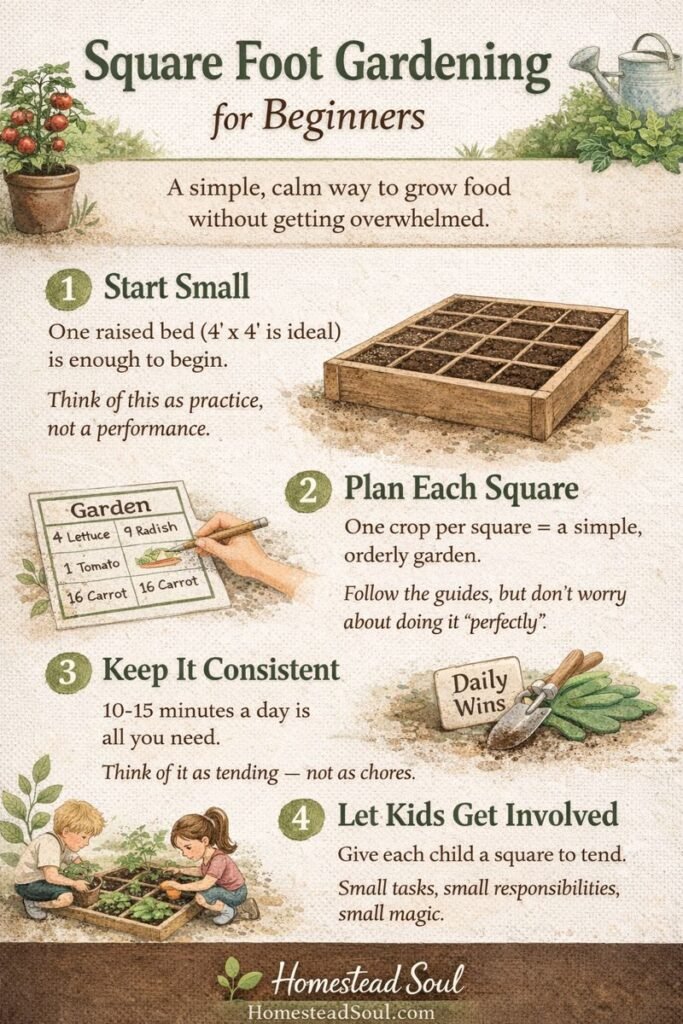
Instead of planting long rows and guessing how much space things need, you divide a garden bed into small, one-foot squares and plant each square intentionally.
That’s it. That’s the whole idea.
A typical square foot garden:
- Is usually a raised bed (often 4×4 feet but the beauty is that it can fit any combination)
- Is divided into equal squares
- Has one type of plant per square (most of the time, but can also encourage interplanting)
- Uses spacing that actually makes sense for beginners
Think of it less like “traditional farming” and more like organizing a drawer.
When everything has a place, things just work better.
Why This Works So Well for Beginners
Traditional gardening often fails beginners because it assumes you already know things like:
- How far apart plants should be
- How much to plant
- How much space you really need
- How to keep things from getting out of control
Square foot gardening removes most of that guesswork.
Instead of asking:
“How many lettuce plants should I grow?”
You’re asking:
“How many fit in this one square?”
That shift matters.
It:
- Prevents overcrowding (the #1 beginner mistake)
- Makes planning less intimidating
- Keeps gardens small and manageable
- Helps you see quick wins instead of chaos
And honestly?
It gives you permission to start small without feeling like you’re doing it wrong.
This Is Gardening for Real Life
Square foot gardening works especially well if you:
- Have a small yard (or no yard at all)
- Are busy and tired and still want dinner
- Want your kids involved without everything getting wrecked
- Don’t want your garden to feel like another job
This isn’t about becoming a “perfect gardener.”
It’s about growing something—successfully—so you actually want to keep going.
And that’s where the real transformation happens.
Who Square Foot Gardening Is Perfect For (And Who It’s Not)
Let’s save you some frustration right now.
Square foot gardening is amazing—but it’s not magic, and it’s not for every single gardening goal. Knowing where it shines (and where it doesn’t) will help you decide if this is the right starting point for you.
Square Foot Gardening Is Perfect If You…
You’re brand new to gardening
If words like spacing, thinning, succession planting, or soil amendments already make your eyes glaze over—this method was made with you in mind.
Square foot gardening gives you just enough structure to succeed without asking you to become an expert first.
You want clear boundaries
One bed. Sixteen squares. One plant type per square.
There’s something deeply calming about that.
Instead of wondering where to plant things or whether you’re doing it “right,” the system gently answers those questions for you.
You’re working with limited space
Backyard, side yard, patio, driveway edge, community garden plot—square foot gardening works anywhere you can fit a raised bed and some sunlight.
You don’t need land.
You don’t need acreage.
You don’t need a farmhouse fantasy.
You need a few square feet and the willingness to try.
You want quick wins
Nothing builds confidence like harvesting something you grew yourself.
Because square foot gardens are small and intentional, they tend to:
- Produce faster
- Look better sooner
- Feel more rewarding early on
That momentum matters—especially in the beginning.
You want your kids involved (without chaos)
Square foot gardening is one of the easiest ways to garden with kids instead of around them.
Each child can have:
- Their own square
- Their own plant
- Their own responsibility
And when something fails (because sometimes it will), it fails small—and safely.
Square Foot Gardening Might Not Be For You If…
And this is important too.
You want to grow massive quantities of one crop
If your dream is 50 tomato plants, long rows of corn, or enough potatoes to last the winter, square foot gardening may feel limiting.
It’s designed for variety, not volume.
You love wide-open, informal garden layouts
Some people thrive with loose, sprawling gardens and intuitive planting.
Square foot gardening is more structured. If measuring, grids, and planning make you itchy, this may not be your forever method—though it can still be a great place to start.
You’re trying to do everything at once
This system works best when you respect its simplicity.
If you immediately want:
- Ten beds
- Dozens of crops
- Complex rotations
- Advanced techniques
You’ll likely overwhelm yourself.
Square foot gardening rewards patience, not intensity.
One Important Reframe
Here’s the mindset shift that makes all the difference:
Square foot gardening doesn’t have to be your identity.
It just has to be your starting point.
Many experienced gardeners began here.
Some stayed with it forever.
Others used it to build confidence before expanding.
All of those paths are valid.
The goal isn’t to “do square foot gardening perfectly.”
The goal is to grow food, learn as you go, and build a rhythm your life can actually sustain.
And next, I’ll show you the simple core idea that makes this system work—without overcomplicating it.
The Core Idea (Explained Like You’re 10)
If you strip square foot gardening down to its simplest form, it comes down to one idea:
Small spaces + clear limits = less overwhelm.
That’s it.
Instead of thinking about an entire garden bed as one big, confusing space, you break it into little one-foot squares and treat each square like its own tiny garden.
Imagine a muffin tin.
You don’t pour all the batter into one giant hole and hope for the best.
Each muffin gets its own spot, its own amount, its own space to rise.
Square foot gardening works the same way.
How the Grid Works
Many square foot gardens use a 4×4 raised bed, which gives you 16 total squares.
Each square:
- Is about one foot by one foot
- Gets a specific number of plants based on what you’re growing
- Is planted intentionally (not scattered and guessed at)
Some squares might hold:
- 1 larger plant (like a pepper or tomato)
- 4 medium plants (like lettuce)
- 9 or more small plants (like carrots or radishes)
You don’t need to memorize these numbers yet—we’ll cover that later.
For now, just understand this:
Each square has a job.
Why This Makes Gardening Easier
Traditional gardening often starts with questions like:
- “How far apart should these be?”
- “Did I plant too many?”
- “Why does everything look crowded already?”
Square foot gardening quietly answers those questions before they turn into frustration.
The grid:
- Prevents overplanting
- Keeps plants from competing for space
- Makes it obvious when something is out of place
- Helps you see progress quickly
It also makes planning feel possible.
Instead of imagining an entire garden season, you’re just deciding:
“What do I want in this one square?”
That’s a much easier question to answer.
This Is a Guide, Not a Rulebook
Here’s something I want you to hear early on:
The grid is a tool, not a law.
You can:
- Shift it
- Adapt it
- Ignore it when needed
Plants don’t own rulers.
Nature is flexible.
The grid exists to help you, not to make you feel like you’re doing something wrong.
If a plant leans into the next square? That’s okay.
If you misjudge spacing once or twice? Welcome to gardening.
This system is forgiving by design.
The One Thing You Should Remember
If you forget everything else in this guide, remember this:
Crowding causes more beginner garden problems than almost anything else.
Most new gardeners plant too close because:
- Seed packets are confusing
- It feels wrong to leave empty space
- We’re afraid of “wasting” soil
Square foot gardening gives plants the space they need—whether it looks like enough at first or not.
Empty space early on is not failure.
It’s growth waiting to happen.
Choosing (or Building) Your First Square Foot Garden Bed
This is usually where people freeze.
They start Googling “best raised bed,” open twelve tabs, see wildly different prices, and suddenly feel like they can’t start until they make the perfect choice.
Let’s gently shut that down.
You do not need the perfect bed.
You need a bed that exists.
Square foot gardening works because it keeps things small and contained. That means your first bed should feel manageable—not like a construction project you’ve been avoiding for three months.
The Best Size for Beginners
If you only remember one thing from this section, remember this:
A 4×4 bed is the classic starting point for a reason.
It’s:
- Big enough to grow a surprising amount of food
- Small enough to reach from all sides
- Easy to divide into 16 clear squares
- Not overwhelming to maintain
That said, it’s not the only option.
Other beginner-friendly sizes:
- 2×4 beds – great for tight spaces or patios
- 2×2 beds – perfect for testing the waters
- Multiple small beds instead of one large one
A smaller bed you care for consistently will always outperform a big bed you avoid.
How Tall Should Your Bed Be?
This is another area people overthink.
Here’s a simple breakdown:
- 6–8 inches tall
Works if you’re placing the bed directly on good soil and want the cheapest option. - 10–12 inches tall
A comfortable middle ground. Easier on your back, better root space. - 16+ inches tall
Great if bending is difficult or you want a very defined space—but not required.
If you’re not sure, aim for the middle. Most vegetables are incredibly adaptable.
Store-Bought vs DIY (Both Are Fine)
You do not need to be handy to have a garden.
Store-bought beds are great if:
- You want something fast
- You don’t own tools
- You want clean lines and less decision-making
DIY beds are great if:
- You enjoy building things
- You want to save some money
- You already have materials on hand
Neither option makes you “more legit.”
Food doesn’t care how pretty the box is.
What About Materials?
If you’re building or choosing a bed, you’ll see lots of opinions here.
Let’s simplify:
- Untreated wood is commonly used and beginner-friendly
- Cedar lasts longer but costs more
- Metal beds work well and last a long time
Avoid stressing about this too much.
Your first bed does not need to last forever—it just needs to last long enough for you to learn.
Placement Matters More Than the Bed Itself
Before you lock anything in, take a moment to notice your space.
Your bed should be:
- In a spot that gets 6–8 hours of sunlight
- Easy to reach with a hose or watering can
- Somewhere you’ll actually see it
The more visible your garden is, the more likely you are to care for it.
Hidden gardens get forgotten.
Visible gardens become habits.
Start With One
I know it’s tempting to plan five beds at once.
Don’t.
Start with one.
Learn what works in your space.
Pay attention to what you enjoy growing.
Notice what your family actually eats.
You can always add more later.
Growing food isn’t a race.
It’s a relationship.
Next, we’ll talk about soil—the part everyone thinks is complicated, but really doesn’t have to be.
Soil: The Part Everyone Overthinks (Let’s Simplify It)
If there’s one place new gardeners tend to spiral, it’s soil.
They hear words like amendments, nutrients, pH balance, and microbiology and suddenly feel like they need a science degree before planting a single seed.
You don’t.
Square foot gardening actually makes soil simpler, not more complicated—because you’re working in a small, controlled space.
Let’s keep this grounded.
Why Soil Matters (But Not in a Scary Way)
Plants get most of what they need from soil:
- Nutrients
- Water
- Support for their roots
If your soil is decent, your plants will forgive a lot of beginner mistakes.
If your soil is poor, even perfect spacing won’t save you.
The good news?
In a square foot garden, you get to choose your soil instead of fighting whatever came with your yard.
That’s a huge advantage.
One Important Rule: Don’t Use Straight Garden Dirt
I’m going to say this plainly because it trips people up every year:
Do not fill a raised bed with dirt from your yard.
Even “nice” yard soil:
- Compacts too easily
- Drains poorly in a raised bed
- Makes roots work harder than they need to
This is one shortcut that almost always backfires.
If you remember nothing else from this section, remember that.
The Simple Square Foot Soil Approach
Traditional square foot gardening uses a specific soil blend—but you don’t need to memorize ratios right now.
What matters is the idea behind it:
You want soil that is:
- Loose and easy to dig
- Holds moisture without staying soggy
- Rich enough to support growth
- Consistent across the whole bed
Many beginners do best with one of these options:
- A high-quality raised bed mix from a garden center
- A pre-mixed square foot gardening blend
- A custom mix made from compost and other organic materials
All of these can work.
Buying soil is not “cheating.”
It’s often the fastest path to success.
How Much Soil Do You Need?
This part feels confusing until you do it once.
For a standard 4×4 bed:
- You’ll need enough soil to fill it to the top
- Most garden centers can help you calculate this
- It’s usually more soil than you expect—and that’s normal
Pro tip:
Slightly overfilling is better than underfilling. Soil settles over time.
Do You Need to Add Fertilizer?
Not right away.
If you’re starting with good soil, most beginner crops will do just fine without extra inputs.
Later on, you might:
- Add compost between plantings
- Refresh soil once or twice a season
- Learn what your plants respond to
But at the beginning?
Healthy soil + water + sunlight is enough.
Let yourself learn before you optimize.
Soil Doesn’t Have to Be Perfect
This is where I want you to take a deep breath.
Your soil will change.
It will improve.
It will teach you things.
Plants are resilient.
They’re not grading you.
Square foot gardening gives you a small, forgiving space to build confidence—one square at a time.
Next, we’ll talk about what to plant first, because early wins matter more than ambitious plans.
What to Plant First (Beginner Wins Only)
This is where gardening starts to feel real.
Choosing the right first plants matters more than choosing the “right” soil, bed, or tools—because early success builds momentum. Early frustration does the opposite.
So for now, we’re aiming for plants that want to grow, not plants that test your patience.
The Best First Crops for Square Foot Gardening
These plants are forgiving, fast, and beginner-approved.
Leafy greens
- Lettuce
- Spinach
- Arugula
Why they’re great:
- Quick to sprout
- Tolerant of small mistakes
- Harvestable multiple times
If you want something you can cut and come again, start here.
Radishes
Radishes are the confidence booster of the garden world.
- They sprout fast
- They mature quickly
- They clearly show progress
They’re also great for kids because something actually happens in a short amount of time.
Green onions
You can:
- Grow them from seed
- Regrow them from kitchen scraps
- Harvest a little at a time
They don’t ask for much and still make you feel like a successful human.
Bush beans
Not pole beans. Bush beans.
They:
- Grow compactly
- Don’t need trellising
- Produce generously
They’re a great introduction to fruiting plants without the drama.
Herbs
Especially:
- Basil
- Parsley
- Cilantro
Herbs make a square foot garden feel abundant, even when it’s small. A single square can give you weeks of flavor.
Plants to Wait On (Just for Now)
This isn’t a “never.” It’s a “not yet.”
Some plants are better once you’ve had a season or two under your belt.
Consider waiting on:
- Large tomatoes
- Corn
- Melons
- Pumpkins
They need more space, more support, and more attention than most beginners expect.
You’re not behind if you skip them. You’re being wise.
Variety Beats Quantity
Here’s a trap a lot of beginners fall into:
They plant too much of one thing.
Six squares of zucchini sounds exciting… until all six produce at once.
Square foot gardening shines when you:
- Grow a little of many things
- Spread out harvest times
- Learn what your household actually eats
One square of something you love is better than four squares of something you feel guilty about.
Let Your First Garden Be a Test Garden
This is important.
Your first square foot garden is not a statement about who you are.
It’s a test.
Some things will thrive.
Some things won’t.
That’s not failure—it’s information.
Take notes.
Notice what surprised you.
Pay attention to what excited you.
Those observations will shape your next season far more than any guide ever could.
Next, we’ll talk about spacing—the part that feels strange at first, but makes everything work better in the long run.
How Spacing Actually Works (Without the Chart Overload)
This is the part that feels wrong at first.
You plant your seeds.
You step back.
You look at all that empty soil.
And your brain says,
Surely this can’t be right.
It is.
Spacing is where most beginner gardens either succeed or struggle, and square foot gardening was designed specifically to make this part easier.
Why Seed Packets Are So Confusing
Seed packets are written for traditional row gardening.
They assume:
- Long rows
- Lots of space
- Thinning later
- Experience you don’t have yet
So when a packet says:
“Plant 12 inches apart in rows 18 inches apart”
…it’s not actually helping you very much.
Square foot gardening translates that information into something usable:
“This many plants fit comfortably in one square.”
That’s the shift.
The Basic Spacing Logic (No Memorization Required)
Here’s the general idea:
- Large plants = fewer per square
- Small plants = more per square
For example:
- One pepper plant gets its own square
- Four lettuce plants share a square
- Nine carrots share a square
You don’t need to memorize numbers today. You’ll naturally learn them as you go.
What matters more is trusting that:
- Plants need room for roots and leaves
- Airflow helps prevent disease
- Crowding causes stress, even if plants look fine at first
Thinning: The Emotionally Difficult Part
Let’s talk about thinning.
Thinning means removing extra seedlings so the remaining ones can grow properly.
And yes—it feels terrible the first time.
You worked so hard to get things to sprout, and now you’re supposed to pull some of them out?
Here’s the reframe:
Thinning isn’t killing plants.
It’s choosing which ones get to thrive.
If thinning feels impossible, try:
- Snipping extras with scissors instead of pulling
- Viewing it as harvesting baby greens
- Reminding yourself that crowding hurts everything
Your future harvest depends on this step.
What If You Mess Up the Spacing?
You will.
Everyone does.
Maybe you:
- Planted too many seeds
- Misjudged the square
- Let things get crowded longer than planned
That’s okay.
Gardening isn’t about perfect execution—it’s about adjustment.
You can:
- Transplant extras
- Harvest early
- Learn for next time
Plants are far more forgiving than we give them credit for.
Empty Space Is Not Wasted Space
This is worth repeating:
Empty soil early on is not a problem.
It’s room for:
- Roots to expand
- Leaves to grow
- Water to soak in properly
Your garden will fill in.
Resist the urge to overplant “just in case.”
Trust the process.
Next, we’ll cover watering, sunlight, and the bare minimum maintenance you need to keep things growing without turning this into another chore.
Watering, Sunlight, and the Bare Minimum Maintenance
One of the biggest myths about gardening is that it requires constant attention.
It doesn’t.
What it does require is consistency—but not perfection. Square foot gardening keeps maintenance simple because everything is contained and visible.
Let’s talk about the basics.
How Much Sun Do You Actually Need?
Most vegetables prefer 6–8 hours of sunlight per day.
That said, “full sun” doesn’t mean:
- Blazing heat all day
- No shade ever
- A perfect southern exposure
Many beginner crops (especially leafy greens) will still grow with a little less.
If your space gets:
- Morning sun → great
- Afternoon sun → great
- Dappled light → workable for some crops
The goal is “enough,” not “ideal.”
How Often Should You Water?
This is the question everyone asks—and the answer depends on your weather, soil, and plants.
But here’s a beginner-friendly guideline:
Water when the top inch of soil feels dry.
Stick your finger in the soil.
If it’s dry, water.
If it’s still moist, wait.
That’s it.
Most square foot gardens need watering:
- More often in hot weather
- Less often in cool or rainy periods
Avoid strict schedules. Plants don’t read calendars.
How to Water Without Overthinking It
- Water slowly so it soaks in
- Aim for the soil, not the leaves
- Morning is ideal, but not mandatory
If you miss a day?
Your garden will forgive you.
If you overwater occasionally?
You’ll learn quickly.
This is not fragile work.
Mulch: The Quiet Helper
Mulch is anything that covers the soil surface.
It helps:
- Keep moisture in
- Reduce weeds
- Protect soil from extreme heat
Simple options:
- Straw
- Shredded leaves
- Untreated wood chips
You don’t need to mulch perfectly. A light layer is enough to make a difference.
How to Tell If Plants Are Unhappy
Plants communicate. You just need to notice.
Common signs:
- Wilting → usually needs water
- Yellowing leaves → often stress or overwatering
- Slow growth → could be crowding or nutrients
Here’s the key:
One bad day doesn’t mean something is wrong.
Look for patterns, not panic.
Make the Garden Easy to Care For
Place your garden where:
- You see it often
- You can water it easily
- You’re reminded it exists
The easier it is to maintain, the more likely it becomes part of your rhythm instead of another obligation.
Next, we’ll talk about common beginner mistakes—so you can recognize them early and not let them derail you.
Common Beginner Mistakes (And Why They’re Normal)
If you garden long enough, you will make mistakes.
Not because you’re careless.
Not because you didn’t research enough.
But because gardening is learned by doing.
Square foot gardening reduces mistakes—but it doesn’t eliminate them. And that’s okay.
Let’s talk about the most common ones so you can recognize them without spiraling.
Planting Too Much, Too Soon
This is the classic beginner move.
You’re excited.
Everything looks possible.
You plant every square with high expectations.
Then:
- Everything grows at once
- You fall behind on watering
- Harvests pile up
- Motivation drops
Starting small isn’t limiting—it’s strategic.
One or two beds are plenty for a first season.
Starting Earlier Than the Weather Allows
Warm days are misleading.
A few sunny afternoons do not mean it’s time to plant everything.
Cold soil slows growth.
Frost kills tender plants.
Seeds rot instead of sprouting.
Waiting feels hard—but it saves disappointment.
If you’re unsure, err on the side of patience.
Overwatering (Out of Love)
Most beginners don’t underwater—they overwater.
Not because they’re negligent, but because they care.
Soggy soil:
- Suffocates roots
- Encourages disease
- Slows growth
Remember:
Moist is good.
Saturated is not.
Trust your finger test.
Forgetting to Thin
You meant to thin.
You really did.
But the seedlings were cute, and you didn’t want to pull them.
So you waited.
And waited.
And suddenly everything was crowded.
This happens to everyone.
Next time, thin earlier than feels comfortable. Your plants will thank you.
Comparing Your Garden to the Internet
This one is sneaky.
Online gardens:
- Are photographed at peak moments
- Often belong to experienced growers
- Don’t show failures
Your garden is real.
It’s learning.
It’s allowed to look like it’s figuring things out.
Comparison steals joy—and confidence.
Quitting After One “Bad” Season
This is the biggest mistake of all.
A slow start.
A few failed crops.
An unexpected pest.
None of that means you failed.
It means you gathered information.
Gardening rewards persistence far more than perfection.
A Better Way to Measure Success
Instead of asking:
“Did everything work?”
Try asking:
- What surprised me?
- What did my family actually eat?
- What would I plant again?
- What would I skip next time?
Those answers are how you grow—not just plants, but confidence.
Next, we’ll talk about square foot gardening with kids, because this method shines when it becomes something the whole family shares.
Square Foot Gardening With Kids (Without Losing Your Mind)
If you’ve ever tried to garden with kids, you already know the tension.
You want them involved.
They want to dig, touch, pull, and “help.”
Somewhere in the middle… a plant gets uprooted.
Square foot gardening makes gardening with kids workable—not perfect, but workable—because it gives clear boundaries and small responsibilities.
And kids thrive with both.
Give Each Child a Square
This is one of the simplest and most effective things you can do.
Instead of saying, “Help me in the garden,” try:
“This square is yours.”
One square:
- Feels manageable
- Creates ownership
- Limits damage (intentionally or otherwise)
Let them choose what goes in it—even if you wouldn’t have picked that plant yourself.
The goal isn’t efficiency.
It’s connection.
Choose Crops That Reward Attention Spans
Kids need feedback quickly.
Great kid-friendly options include:
- Radishes
- Lettuce
- Green onions
- Herbs
- Bush beans
Plants that grow fast help kids stay engaged long enough to care.
Waiting three months for a harvest is hard when you’re six.
Let It Be Imperfect
This part is important.
Your child’s square:
- Might be uneven
- Might be overwatered
- Might not produce much
That’s okay.
Learning happens through doing—not through watching adults do everything “right.”
When a plant fails, resist the urge to fix it immediately.
Ask questions instead:
- “What do you think happened?”
- “What should we try next time?”
That curiosity matters more than the outcome.
Gardening Builds More Than Food
When kids garden, they learn things you can’t really teach with words:
- Where food comes from
- That growth takes time
- That effort doesn’t always guarantee results
- That trying again matters
Square foot gardening keeps those lessons small, visible, and repeatable.
And when kids eat something they grew themselves?
That’s a quiet kind of magic.
Keep the Bar Low
You don’t need:
- Perfect labels
- Matching tools
- Educational worksheets
You need:
- Dirt
- Curiosity
- Permission to be messy
Gardening with kids isn’t about producing more food.
It’s about producing familiarity—with effort, patience, and the living world around them.
Next, we’ll talk about scaling up—what to do when your first bed works and you start thinking, “Okay… maybe I could do a little more.”
Scaling Up (When You’re Ready — Not Before)
This is the point where many people either rush… or freeze.
Your first bed is working.
You’ve harvested a few things.
Confidence is quietly building.
And then the questions start:
- “Should I add another bed?”
- “Am I doing enough?”
- “What’s the next step?”
Here’s the truth:
You don’t need to scale up to be a ‘real’ gardener.
But if you want to, square foot gardening makes it simple.
Add One Bed at a Time
If your first bed feels manageable—meaning:
- You keep up with watering
- Harvests don’t stress you out
- The garden still feels enjoyable
Then adding one more bed is a natural next step.
Not three.
Not five.
One.
Each new bed teaches you something different:
- Sun patterns
- Soil behavior
- What your family actually eats
Growth doesn’t need to be dramatic to be meaningful.
Try Succession Planting (Lightly)
Succession planting just means planting something new once something else is done.
For example:
- Lettuce finishes → plant bush beans
- Radishes are harvested → plant herbs
- Spring crops end → summer crops begin
You don’t need a complex plan.
Simply ask:
“What’s ready to come out—and what could take its place?”
That’s enough for now.
Pay Attention to Seasons
One of the biggest shifts happens when you stop fighting the season you’re in.
Instead of trying to grow everything all the time, square foot gardening encourages you to:
- Grow what fits the moment
- Let beds rest when needed
- Learn your local rhythms
Your garden doesn’t need to be productive year-round to be successful.
Rest is part of the cycle.
Keep Notes (Casually)
You don’t need a formal journal.
A few notes in your phone or planner is plenty:
- What worked
- What didn’t
- What you’d grow again
- What surprised you
These small reflections will guide your decisions far better than any expert advice.
Expansion Should Feel Like Curiosity, Not Pressure
If you ever feel like scaling up is becoming stressful, pause.
You’re not behind.
You’re not missing out.
You’re not doing it wrong.
Square foot gardening is about building a rhythm—not chasing an ideal.
And that rhythm looks different for every household.
Next, we’ll wrap things up by answering an honest question many beginners ask themselves:
Is square foot gardening actually worth it?
So… Is Square Foot Gardening Actually Worth It?
Short answer?
Yes—if your goal is to grow food in a way that fits real life.
Square foot gardening won’t turn you into a self-sufficient homesteader overnight. It won’t replace the grocery store. It won’t make every plant thrive every time.
But that’s not what it’s for.
Square foot gardening is worth it because it:
- Lowers the barrier to starting
- Turns overwhelm into action
- Builds confidence through small wins
- Creates consistency instead of intensity
It’s a method that respects your time, your space, and your learning curve.
And that matters.
This Isn’t About Doing It “Right”
I want to say something clearly before you close this page:
You do not need to master square foot gardening to benefit from it.
You don’t need:
- Perfect spacing
- Beautiful grids
- High yields
- A picture-worthy garden
You need:
- A willingness to start
- A little patience
- Grace for yourself when things don’t go as planned
Gardening isn’t a performance.
It’s a practice.
What Success Actually Looks Like
Success might look like:
- One raised bed instead of five
- A handful of lettuce you actually eat
- A child proudly harvesting “their” square
- Learning what not to plant next time
Those things count.
They’re not small. They’re foundational.
If You’re Wondering What to Do Next
Here’s a simple path forward—no rush required.
- Decide if square foot gardening feels doable for you
- Start with one bed (or even one container)
- Choose just a few beginner-friendly plants
- Let this season teach you something
You don’t have to plan the whole year.
You don’t have to do it perfectly.
You don’t have to earn your way into this life.
You’re allowed to begin where you are.
A Gentle Next Step
If this guide helped you feel calmer, clearer, or more confident, here are a few ways to keep going—only if and when you’re ready:
- Save this guide and come back to it as the season unfolds
- Explore beginner-friendly planting and planning resources
- Start a simple garden planner you can use with your family
- Join us as we build a slower, more grounded way of growing food
Square foot gardening isn’t about proving anything.
It’s about learning how to tend something small—until it changes you more than you expected.